

Money as a Service
Digital cash was only the beginning. The next contest is over the software layer around money itself.

For the past decade, the dominant narrative surrounding digital finance has focused almost exclusively on the token. Market participants spent years debating which cryptographic asset would become the definitive internet-native dollar, or whether public blockchains could support global retail payment volume. Ultimately, the arrival of issuer-led stablecoins solved the challenge of digital cash, demonstrating that fiat-backed liabilities could move natively on distributed ledgers.
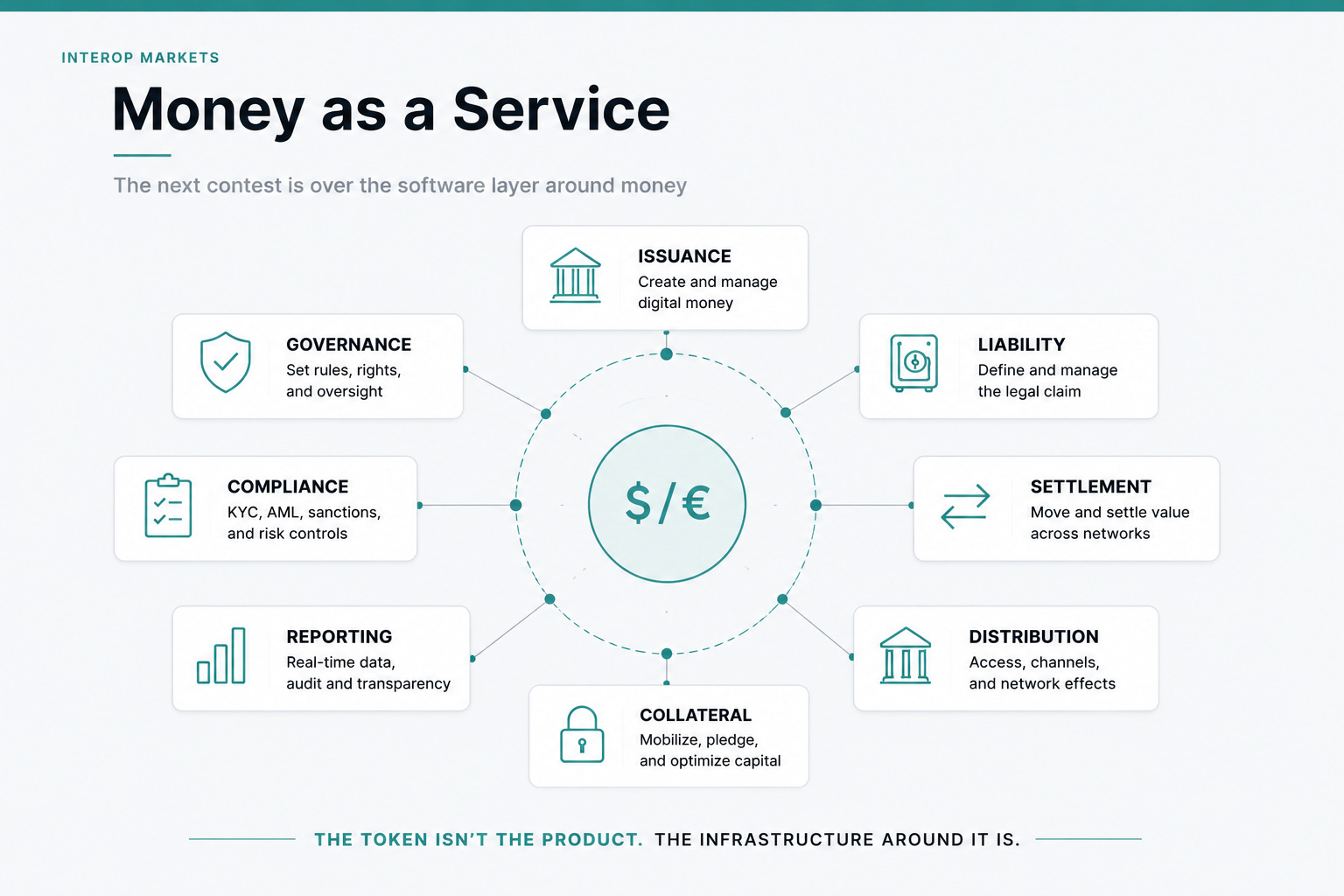
Yet, treating the token as the final destination misinterprets the structural shift currently underway. The market has moved beyond asking which token can represent a dollar or a euro on-chain. The real contest is over which institutions get to control the software layer around money. Specifically, the battles are being fought around how issuance, liability design, settlement, distribution, collateral, governance, compliance, redemption, and reporting are programmed.
Consequently, looking for “the next stablecoin” misses the point. Initiatives like Open USD, Qivalis, tokenized deposits, tokenized money market funds, and sovereign on-chain instruments like USDM1 are distinct attempts to turn traditional pieces of financial market structure into software.
The First App
To understand the current shift toward Money as a Service, we start with the limitations inherent in the first generation of digital cash. The original issuer-led stablecoin model from companies like Tether and Circle established the foundational proof of concept. Under this straightforward architecture, issuers accepted fiat deposits, maintained reserves in cash and short-term government securities, managed redemptions, and captured the underlying interest income.
This model successfully created highly transferable, liquid digital dollars that found deep utility in crypto-native trading, cross-border remittance, and decentralized finance. However, as these assets scaled into hundreds of billions of dollars, their operational footprint revealed that digital cash had evolved into an incredibly powerful commercial control point.
By operating the primary issuance and redemption architecture, single issuers captured massive net interest margins on reserve assets while forcing ecosystem participants (exchanges, payment processors, wallets, and banks) to absorb the operational costs of distribution and integration. The broader financial ecosystem realized that routing volume to someone else’s proprietary money layer meant leaving both economics and operational control on the table. The first stablecoin model solved the digital cash problem, but it also catalyzed an institutional race to re-engineer who captures the value of the software layer.
Distribution Wants the Margin
The emergence of Open USD, orchestrated by Open Standard, illustrates how institutions are actively rewriting the economic logic of stablecoin issuance. Open USD is not designed as another standalone dollar token competing for retail wallet share. Instead, it is a consortium-led architecture where reserve income, governance, and distribution incentives are structurally redesigned.
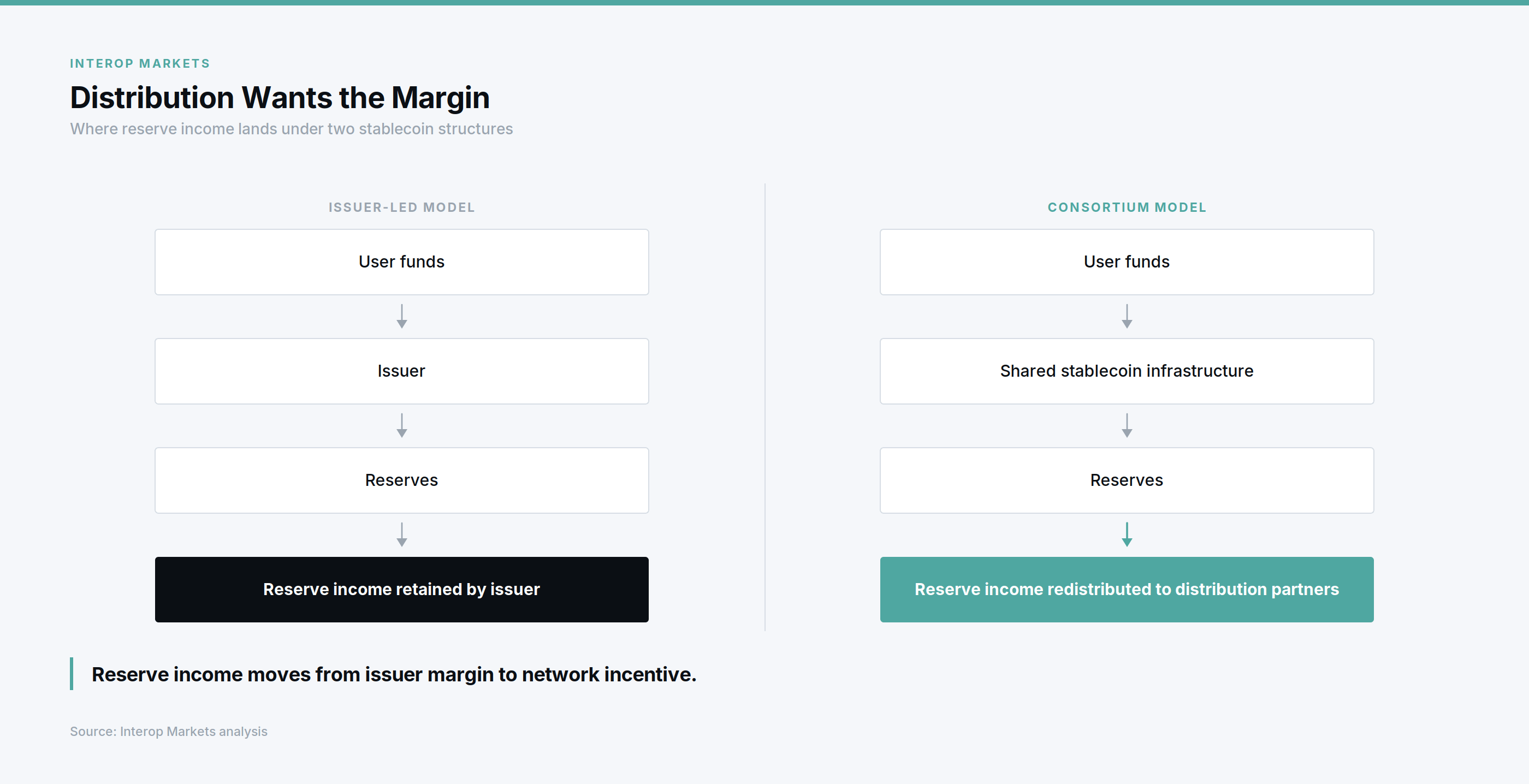
Open Standard notes that more than 140 businesses have signed up as partners, spanning payments, banking, technology, and crypto platforms. The roster features prominent entities including Visa, Mastercard, Stripe, Coinbase, and BlackRock, though initial commitment levels appear to vary across participants and several listed firms have clarified that their involvement remains preliminary. While this operational nuance is important, it underlines the core strategic shift underway. The Open USD architecture is designed to repurpose reserve income, converting traditional spread income into an active incentive budget dedicated to distribution channels.
Traditional issuers retain interest income as corporate profit. In contrast, the Open Standard model proposes to return the vast majority of reserve income, or all of it less a management fee, to the participants who actively adopt and distribute the asset. Conceptually, the reserve pool is being treated as a network incentive rather than a single issuer’s profit centre.
The model also introduces zero-cost minting and redemption alongside the elimination of volume caps for its institutional partners. It’s an interesting strategy. The companies creating the actual demand for digital cash, including payment processors embedding checkout options, fintechs managing treasury flows, and wallets routing volume, do not want merely to route volume to someone else’s money layer. They want a proportional share of the float they help generate.
However, because Open USD is a novel structural experiment, critical caveats remain. The exact yield-sharing formulas, the specific tiering of governance rights among the 140+ participants, and the final binding operational commitments of these large institutions still need to be proven in production environments. If the model functions as intended, it transforms money from a product sold by a single vendor into shared, incentivized infrastructure.
Banks Defend the Liability Layer
While fintechs and payment networks experiment with consortium stablecoins to capture distribution economics, commercial banks are approaching the software layer from a fundamentally different legal starting point. The rise of tokenized deposits represents a direct defense of the banking system’s core asset. Tokenized deposits allow commercial banks to keep traditional liabilities native to programmable settlement environments.
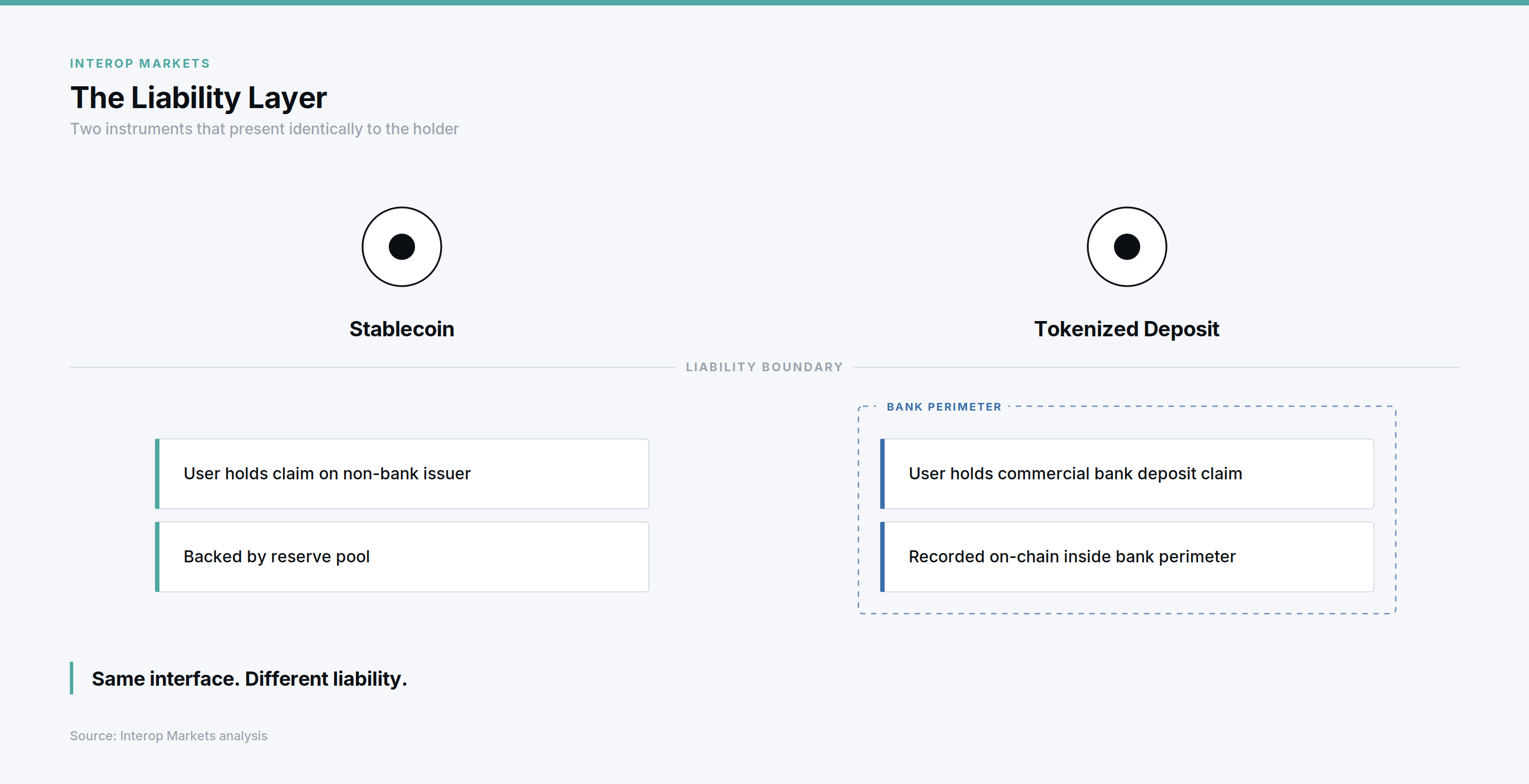
While a stablecoin and a tokenized deposit may look identical at the user interface layer (both operating as digital entries moving across a ledger) they serve distinct functions within the institutional landscape. A stablecoin operates as a claim on a non-bank issuer, typically backed by a segregated pool of reserves. Conversely, a tokenized deposit extends the existing regulatory and legal framework of commercial bank money directly on-chain, maintaining its status as a direct liability of the depository institution.
Initiatives like J.P. Morgan’s Kinexys platform, which utilizes JPM Coin and deposit-token infrastructure, demonstrate this approach. By wrapping traditional deposits in a programmable software shell, the bank allows institutional clients to execute 24/7 cross-border payments, automate treasury management, and post margin without ever moving their cash outside the regulated perimeter of the bank.
Unlike most stablecoins, deposit tokens can potentially support interest payouts under the same logic as traditional commercial bank deposits. In JPMorgan’s case, that feature is still described as planned or in development, subject to internal review and any required regulatory approvals.
On a systemic scale, The Clearing House is designing a shared platform for seventeen U.S. banks to clear and settle tokenized deposits. By connecting on-chain settlement directly to CHIPS and Real-Time Payments infrastructure, this network establishes a unified interbank layer for commercial bank money rather than a fragmented series of single-bank products. The strategic priority is to integrate programmable tokenized flows natively within the existing regulated monetary perimeter.
A significant caveat applies to this architecture, as tokenized deposits may ultimately be better suited for closed-loop institutional settlement than for open, public distribution. Because bank-controlled systems must operate within strict KYC, AML, and banking environments, they cannot easily achieve the same borderless portability and composability that public stablecoins enjoy. Ultimately, these networks elect to prioritize deep institutional compliance over broad distribution.
Jurisdiction Enters the Stack
As money becomes software, geographic boundaries and regulatory frameworks are being coded directly into the assets themselves. This phenomenon is clearest in Europe with the development of Qivalis, a joint venture formed by a prominent consortium of European banks to launch a euro-denominated stablecoin. Qivalis demonstrates that programmable money is becoming a form of jurisdictional infrastructure.
Operating as an Electronic Money Institution under Dutch law and designed to comply fully with the European Union’s Markets in Crypto-Assets regulation (MiCA), Qivalis is structured specifically to address the realities of the European market. The underlying MiCA framework mandates strict 1:1 backing by reference reserves, absolute reserve segregation, and an explicit prohibition on paying interest to token holders.
This interest prohibition dictates that Qivalis cannot compete as a yield-bearing asset. Instead, it must compete entirely on utility, regulatory trust, and institutional distribution through existing European banking channels. The participation of 37 European banks across multiple countries, with launch targeted for the second half of 2026 subject to Dutch central bank authorization, indicates a broader geopolitical motive: Europe does not want tokenized asset markets, corporate settlement, and future collateral flows to default entirely to dollar-denominated stablecoins. Qivalis is an attempt to ensure that the euro has a native, compliant address in the programmable finance ecosystem, leveraging Fireblocks’ infrastructure layer to enforce compliance rules directly at the token level.
The clear downside to this model is its economic friction. MiCA’s strict ban on yield means that during periods of high interest rates, holding non-interest-bearing e-money tokens represents a substantial opportunity cost for corporate treasurers. Consequently, adoption will depend heavily on whether the operational efficiencies of real-time wholesale settlement can outweigh the lack of financial return.
Collateral Learns to Move
While payments dominate public discussion, the largest concentration of institutional liquidity does not sit in cash accounts; it resides in collateral markets. For institutional investors, bank executives, and asset managers, the transformation of money market funds into programmable collateral is arguably the most significant development in the modern market structure.
In traditional finance, the cash leg of a transaction is only half the battle. Wholesale financial markets depend on highly complex collateral workflows that encompass initial and variation margin for derivatives, repo agreements, securities lending, and central counterparty eligibility schedules. These networks are bound by rigid frameworks governing haircuts, valuation feeds, and default management procedures. Moving these assets under legacy systems remains slow, fragmented, and operationally intensive, routinely requiring multiple days for settlement and manual tri-party reconciliation.
Recent joint research and sandbox executions by Global Digital Finance and the International Swaps and Derivatives Association, powered by Ownera’s network architecture, brought together more than 300 participants across 120 firms, including BlackRock, Citi, J.P. Morgan Asset Management, and State Street, to test tokenized MMFs for collateral mobility. These sandbox simulations evaluated whether tokenized fund shares could be legally recognized, operationally controlled, and successfully transferred to satisfy margin requirements under Uncleared Margin Rules and cleared derivatives frameworks.
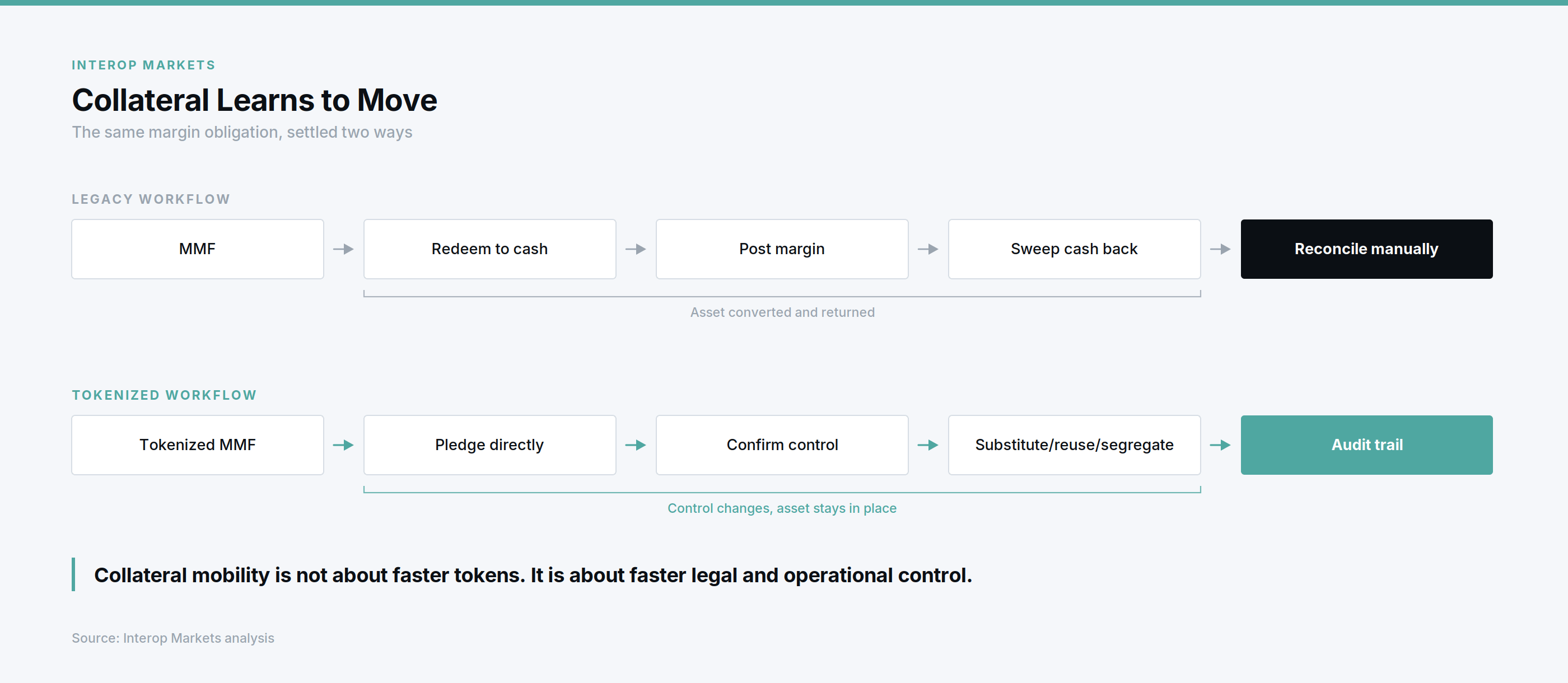
The core takeaway from these institutional trials is that tokenization functions as an efficiency layer over existing legal and operational rails, not a replacement for them. The legal claim remains a share in an SEC-registered fund; the regulatory compliance continues to follow standard securities laws. What changes is the operational velocity. By turning fund shares into tokens, institutions can execute bilateral variation margin updates and cleared initial margin cascades in minutes rather than days.
This operational reality is reinforced by the commercial scaling of BlackRock’s BUIDL tokenized U.S. Treasury fund. The asset has accumulated billions in assets due to its specific utility as highly efficient, off-exchange collateral. Large institutional traders utilize the token to satisfy margin requirements on major trading platforms while continuing to accrue the underlying yield of the fund’s Treasury assets. Ultimately, the core institutional challenge extends far beyond basic token portability. Success requires that the underlying legal claim, collateral schedule, custody model, margin system, settlement finality, and default process move synchronously with the digital record.
The Category Breaks Open
The expansion of the software layer around money is breaking traditional asset definitions entirely. A prime boundary case is USDM1, an instrument developed by M1X Global and issued natively on-chain by the Republic of the Marshall Islands. USDM1 matters because it breaks the mental categories that market participants use to organize digital assets. It is explicitly not a stablecoin, not a tokenized money market fund, and not a central bank digital currency. Instead, it is framed as a sovereign debt instrument issued directly on a ledger.
According to M1X’s public materials, USDM1 is structured in the style of a fully collateralized Brady bond, backed 1:1 by short-duration U.S. Treasuries held in bankruptcy-remote custody, and designed to operate as ISDA-compatible collateral for institutional derivatives markets.
In traditional derivatives trading, closeout netting allows institutions to offset counterparty obligations, drastically reducing the net capital they must post as margin. Conventional stablecoins are corporate liabilities that are operationally transferable but lack the legal status required for formal ISDA netting. Tokenized MMFs represent equity in a fund, which carries a different risk profile. USDM1 attempts to bridge this gap by offering a sovereign debt wrapper that carries dual recourse, allowing institutions to treat the token itself as a highly capital-efficient collateral asset under New York law.
A necessary institutional caveat applies to these developments, as claims regarding the Brady bond-style architecture, seamless netting capabilities, and ultimate capital efficiencies of USDM1 are driven by M1X Global’s design framework. However, they remain to be fully validated by global systemic clearinghouses and prime brokers. Nevertheless, the instrument demonstrates the essential truth that the label matters far less than the underlying institutional function. Future financial primitives will routinely blur traditional lines, behaving like money in settlement, like collateral in financing, and like securities in law.
The Interface Owns the Flow
As the technical barriers to issuing programmable money fall, the underlying economics of the business shift dramatically. When any qualified financial institution or consortium can deploy a compliant, stable token, the token itself becomes a commoditized asset. As digital money becomes easier to issue, the scarce asset shifts from issuance to placement.
The true commercial value is migrating to the interface layer, the software distribution channels where corporate and retail money already moves. The firms that control the workflows, the developer APIs, and the client relationships are positioned to capture the operational margin, regardless of which specific token sits underneath.
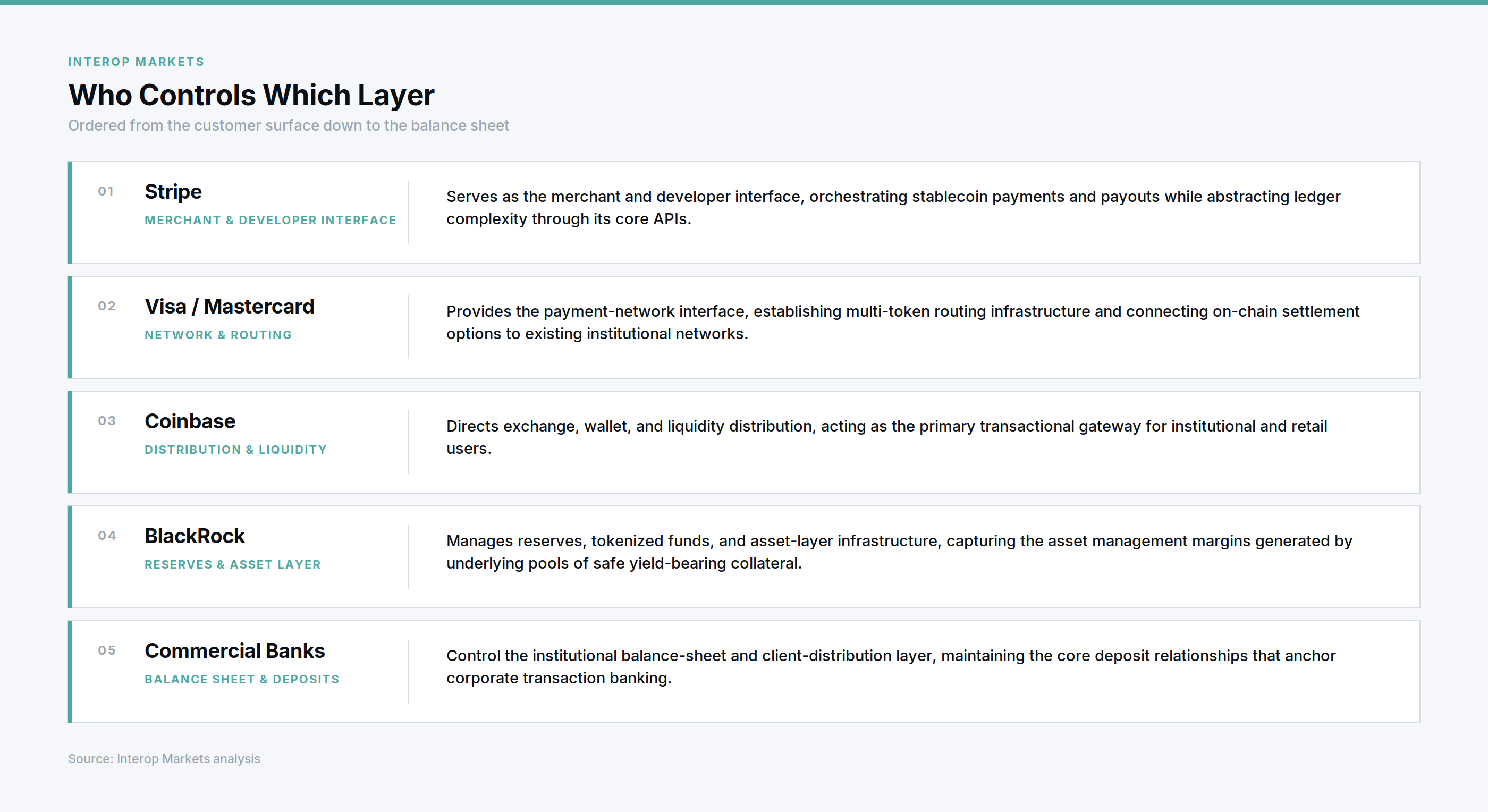
Stripe’s acquisition of Bridge highlights this dynamic. By embedding stablecoin orchestration directly into its core API, Stripe allows merchants to accept digital cash natively, abstracting away the underlying blockchain complexities while charging a standard transaction fee. Stripe does not need to issue its own stablecoin; it monetizes the interface that routes it.
Similarly, Visa and Mastercard are focused on becoming the universal routing layer, ensuring that whether a transaction settles via a traditional card network, an Open USD consortium rail, or a bank-led tokenized deposit, the network continues to extract value from the flow.
For asset managers like BlackRock, the opportunity lies in managing the massive pools of tokenized reserves and money market funds that back these software layers. The issuance of money is becoming a feature of broader distribution platforms, meaning that the interface owners will ultimately dictate which assets win market share.
The Software Layer Around Money
To navigate this shifting landscape, market participants require a clear framework that separates the token from its functional components. Money as an institutional software stack can be broken down into seven distinct layers, each operated by different entities and governed by different rules:
Issuance: Who creates the underlying financial claim?
Liability: What does the holder legally own?
Settlement: How does the asset move?
Distribution: Where does the asset appear?
Collateral: Can the asset be pledged, substituted, reused, segregated, and liquidated within standard risk frameworks?
Governance: Who sets the operational rules, controls the code upgrades, and manages the reserve composition?
Compliance and Reporting: How are legal constraints, AML/KYC checks, and automated audit trails enforced throughout the life cycle of the asset?
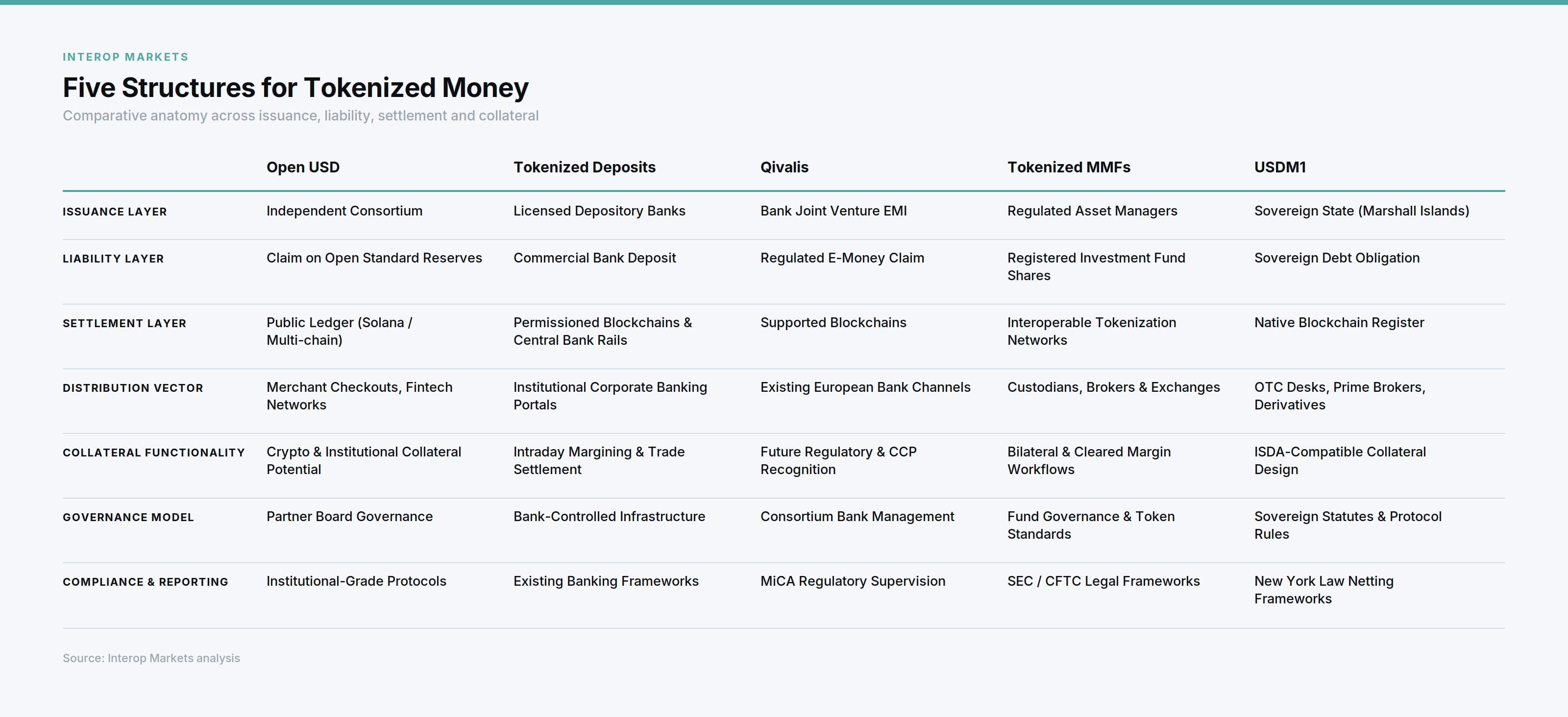
When applied to the current market developments, this framework reveals that institutions are choosing entirely different vectors of programmability. Open USD makes reserve economics and distribution programmable, converting issuer margins into a collaborative incentive pool. Tokenized deposits make commercial bank liabilities programmable, allowing traditional bank money to survive in automated settlement environments. Qivalis makes jurisdictional money programmable, embedding European regulatory compliance directly into the token’s operational perimeter. Tokenized MMFs make collateral workflows programmable, unlocking liquidity and capital efficiency for complex margin markets without altering the underlying securities law. Finally, sovereign instruments like USDM1 attempt to make sovereign collateral logic programmable, bringing legal netting features directly to the protocol layer.
Money Becomes Institutional Software
Digital finance is growing up. Stablecoins successfully made digital cash programmable, but that achievement marks the baseline of the transition, not its conclusion. The next phase is making the surrounding functions of money programmable as well. Issuance becomes software. Distribution becomes software. Collateral eligibility becomes software. Settlement finality, compliance, reporting, and governance are all transitioning into software modules.
This shift will not culminate in some binary outcome where a single asset or architecture replaces the existing financial system. The institutional reality is far more nuanced. Different forms of programmable money will become native to different operational workflows. Closed-loop tokenized deposits may become most relevant in wholesale interbank settlement and high-value corporate treasury operations where bank relationships are paramount. Consortium stablecoins will scale across global commercial payments, fintech platforms, and developer-centric internet checkout architectures. Meanwhile, tokenized money market funds and native sovereign debt instruments will secure their positions within derivatives markets, repo desks, and institutional collateral networks.
The long-term value will not reside in the asset wrapper itself, but in the efficiency, compliance, and capital optimization that the software layer provides to the end user. Digital cash was only the beginning. The real contest is over the software layer around money itself.